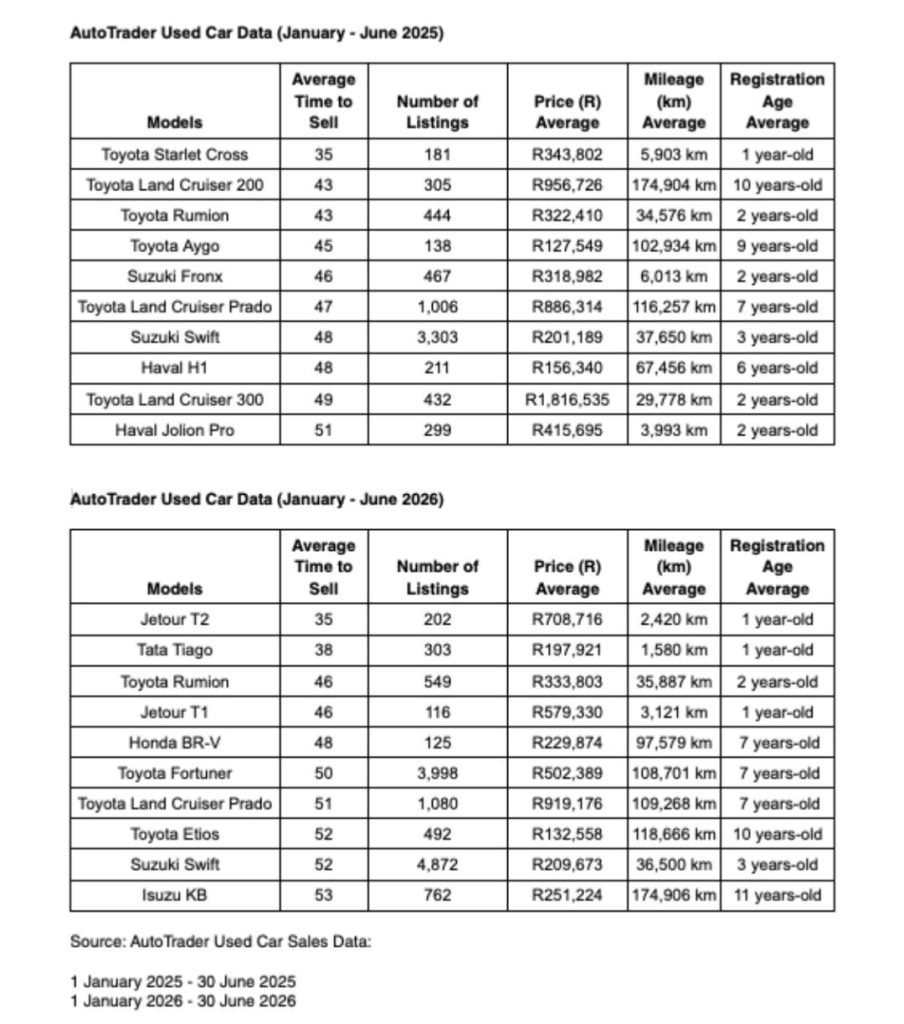
Data for the first half of 2026 shows several recently introduced models selling quickly, while established vehicles such as the Toyota Fortuner and Suzuki Swift continue to turn substantial volumes.
For used-car dealers, the amount of time a vehicle spends on the floor is almost as important as the margin it eventually delivers. Quicker stock turn means less capital tied up in inventory, lower holding costs and more opportunities to replace sold vehicles with stock suited to current demand. A vehicle that takes too long to find a buyer, meanwhile, may require price adjustments that begin to reduce the return.
According to the latest AutoTrader data, South Africa’s fastest-selling used vehicles changed considerably between the first half of 2025 and the same period in 2026. Only three models appeared in the top ten in both periods, while recently introduced products from Jetour and Tata moved into the leading positions.
To prevent low-volume transactions from distorting the results, the analysis was limited to models with at least 100 vehicles represented in the data during each six-month period. Without a reasonable volume threshold, a small number of sales can produce unusually short average selling times that are not necessarily representative of sustained market demand.
The fastest-selling qualifying vehicle took an average of 35 days to sell in both periods. In 2025, that vehicle was the Toyota Starlet Cross. In 2026, it was the Jetour T2.
Recently introduced models move quickly
The Jetour T2 recorded an average selling time of 35 days between January and June 2026. The average example sold for R708,716, had travelled just 2,420 km and carried a 2025 registration year.
This suggests that much of the available T2 stock was nearly new, which is not unusual for a recently introduced brand or model. Low-mileage vehicles may enter the used market through demonstrator fleets, trade-ins or customers changing vehicles shortly after purchase.
Jetour’s smaller T1 also appeared in the top ten, averaging 46 days to sell. It had an average price of R579,330, mileage of 3,121 km and a 2025 registration year.
The T2 was represented by 202 vehicles in the data, while the T1 accounted for 116. Both comfortably met the minimum threshold, although their volumes remained considerably lower than those of established models such as the Toyota Fortuner and Suzuki Swift.
The presence of two Chinese-brand vehicles in the top ten was not new in itself. The Haval H1 and Jolion Pro both appeared in the 2025 ranking. What changed was their position in the order. The H1 and Jolion Pro sat eighth and tenth, respectively, in 2025, with average selling times of 48 and 51 days. A year later, Jetour occupied two of the first four positions, including the fastest-selling model overall.
The pricing is also notable. The Haval H1 averaged R156,340 in 2025, while the Jolion Pro averaged R415,695. By comparison, the T1 and T2 averaged R579,330 and R708,716, respectively. Quick stock turn for Chinese-brand vehicles is therefore no longer confined to the more affordable end of the market.
The Tata Tiago placed second overall, averaging 38 days to sell. Like the two Jetour models, the typical example was almost new, with average mileage of 1,580 km and a 2025 registration year.
At an average selling price of R197,921, however, the Tiago occupied a very different part of the market from the T2. The two fastest sellers therefore sat at opposite ends of the price range, indicating that quick stock turn was not restricted to cheaper vehicles or more aspirational SUVs.
In the first half of 2025, the Toyota Starlet Cross led the ranking with the same 35-day average. At the time, the average vehicle sold for R343,802, had covered 5,903 km and carried a 2024 registration year.
The Starlet Cross did not feature among the ten fastest sellers in 2026. This does not necessarily indicate a significant decline in demand, as a relatively small change in selling time may be enough to move a vehicle outside the top ten. It does, however, show how quickly the composition of the ranking can change as new products reach the used market.
More affordable vehicles gain ground
Despite the Jetour T2 taking first place, the broader ranking shifted towards more affordable vehicles in 2026. Five of the ten models had an average selling price below R300,000: the Toyota Etios, Tata Tiago, Suzuki Swift, Honda BR-V and Isuzu KB. In 2025, only the Toyota Aygo, Haval H1 and Suzuki Swift fell below that mark.
The median selling price among the ten models consequently declined from approximately R333,106 in 2025 to R292,514 in 2026. Taken as a simple average across the ten model-level prices, the figure fell from R554,554 to R406,466.
This should not be interpreted as evidence that used-car prices generally declined. The change reflects the models appearing among the fastest sellers, with the expensive Land Cruiser 200 and Land Cruiser 300 dropping out of the latest ranking and more accessible choices such as the Tiago, BR-V and Etios taking their place.
For dealers, however, the greater representation of sub-R300,000 vehicles is relevant. Although newer, higher-priced SUVs can sell quickly, there remains considerable demand for stock positioned closer to the affordable end of the market.
Practical vehicles retain their appeal
The Toyota Rumion was one of only three models to appear in the top ten in both periods. It took an average of 43 days to sell in the first half of 2025 and 46 days in 2026. Over the same period, the number of vehicles represented rose from 444 to 549, while the average selling price increased from R322,410 to R333,803.
The three-day increase in selling time should therefore be considered alongside the almost 24% increase in volume. The market absorbed more Rumions at a slightly higher average price, while the model remained among the country’s quickest-selling used vehicles. The Honda BR-V also featured prominently in the 2026 data, averaging 48 days to sell. The average example was registered in 2019, had covered 97,579 km and sold for R229,874.
Together with the Rumion and Toyota Fortuner, the BR-V’s inclusion points to continued demand for practical vehicles offering additional seating and family-focused packaging. Importantly for dealers, that demand was not limited to low-mileage or nearly new stock.
The average Fortuner in the data was registered in 2019, had travelled 108,701 km and sold for R502,389. Despite its age, mileage and relatively high purchase price, it took an average of only 50 days to sell.
The Fortuner was also represented by 3,998 vehicles, considerably more than most of the models ahead of it in the ranking. While several newer vehicles achieved shorter average selling times, the Fortuner’s result was recorded across a much deeper pool of stock.
For dealers, that distinction matters. A model selling in 35 days across approximately 200 vehicles reflects strong interest, but one averaging 50 days across almost 4,000 represents a different level of repeatable demand.
Fewer Toyotas, but considerably more variety
Toyota occupied six of the ten positions in the first half of 2025. The Starlet Cross, Land Cruiser 200, Rumion, Aygo, Land Cruiser Prado and Land Cruiser 300 gave the manufacturer representation across compact cars, family vehicles and large SUVs. That number fell to four in 2026, with the Rumion, Fortuner, Prado and Etios making the list.
The decline does not necessarily point to weaker demand for Toyota products. The four Toyota models in the 2026 top ten accounted for 6,119 vehicles, or just under half of the 12,499 vehicles represented across the complete ranking. The Fortuner alone contributed almost 4,000. Toyota therefore lost some of its breadth in the table, but not its volume strength. Its latest representation also covered several distinct parts of the market, from the R132,558 Etios to the R919,176 Prado.
What did change was the variety of manufacturers represented. The entire 2025 top ten was made up of vehicles from only three brands: Toyota, Suzuki and Haval. In 2026, that increased to six, with Jetour, Tata, Honda and Isuzu joining Toyota and Suzuki.
The ranking has consequently become less concentrated around a small group of established brands. The first four positions alone were shared between Jetour, Tata and Toyota, while Honda and Isuzu appeared further down the order with older, higher-mileage vehicles.
Established models continue to absorb volume
The Suzuki Swift was another model to feature in both years, although its average selling time increased from 48 days in 2025 to 52 days in 2026. On its own, the four-day increase may appear to suggest a slightly weaker stock turn. The volume data provides important context.
The number of Swifts represented increased from 3,303 in the first half of 2025 to 4,872 during the same period in 2026, an increase of almost 48%. Average pricing also rose from R201,189 to R209,673, while average mileage remained relatively stable at approximately 36,500 km.
The market therefore absorbed almost 1,600 additional vehicles, at a higher average price, with only a modest increase in selling time. While the Swift was not among the very quickest individual models, its combination of volume and relatively consistent turn remains significant for dealers.
The Toyota Land Cruiser Prado showed a similar movement. Its average selling time increased from 47 days to 51 days, while its average price rose from R886,314 to R919,176.
The average registration year moved from 2018 to 2019, and average mileage declined from 116,257 km to 109,268 km. Buyers were therefore paying more for slightly newer, lower-mileage vehicles, although dealers were waiting around four days longer to complete a sale.
Older vehicles remain commercially relevant
Not all of the fastest-selling vehicles were recent models with low mileage. The Toyota Etios took an average of 52 days to sell in 2026. The average vehicle was registered in 2016, had covered 118,666 km and sold for R132,558, making it the most affordable model in the latest top ten.
The Isuzu KB was older and had travelled further still. With an average registration year of 2015 and mileage of 174,906 km, it nevertheless took only 53 days to sell at an average price of R251,224.
Their inclusion shows that age and mileage are only part of the purchasing decision. An appropriate asking price and familiarity with the vehicle can continue to support demand even when the stock is more than a decade old or approaching 200,000 km.
The Etios also occupied a part of the market where newer replacement vehicles can require a considerably larger financial commitment. For buyers seeking straightforward, affordable transport, an older vehicle from an established manufacturer may remain preferable to financing a more expensive newer model.
The KB, meanwhile, shows the continued relevance of older bakkies in the used market. Despite having the highest average mileage in the 2026 top ten, it still sold within three days of the Fortuner and two days of the Prado.
The fastest sellers changed, but the overall pace remained similar
Across the ten leading models, the average selling time increased from 45.5 days in the first half of 2025 to 47.1 days in 2026. The difference is relatively small, particularly given the change in the vehicles making up the ranking. Seven of the 2026 top ten did not feature a year earlier, with the Jetour T2, Tata Tiago, Jetour T1, Honda BR-V, Toyota Fortuner, Toyota Etios and Isuzu KB all entering the list.
Those models replaced the Starlet Cross, Land Cruiser 200, Toyota Aygo, Suzuki Fronx, Haval H1, Land Cruiser 300 and Haval Jolion Pro.
The latest ranking covers a notably broad section of the market. Average prices range from R132,558 for the Etios to R919,176 for the Prado, while average registration years stretch from 2015 for the Isuzu KB to 2025 for the Jetour and Tata models.
The Jetour T2 and Tata Tiago delivered the shortest average selling times, but the Fortuner and Swift did so across much greater volumes. At the same time, the increased number of models below R300,000 shows that affordable stock remains an important part of the fast-turning market, even as more expensive Chinese SUVs begin to establish themselves near the front of the ranking.