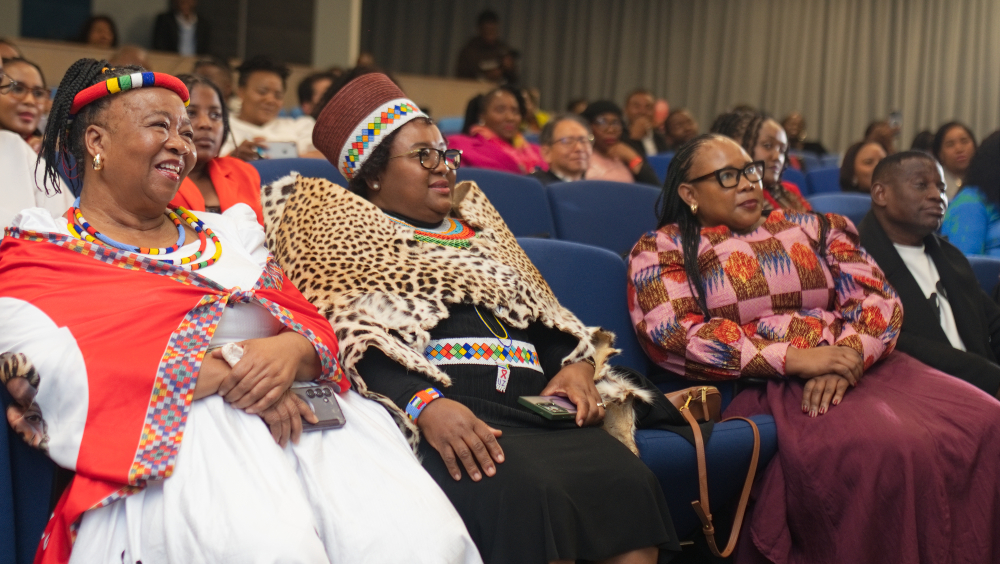
: Her Royal Highness Queen Nompumelelo Mchiza left a room filled with women inspired, reflective and looking towards the future as she shared a deeply personal reflection on legacy, service and the responsibility of creating opportunities for the next generation at the Afri-Masterclass Women’s Month Edition in Sandton.
As the Guest of Honour and special speaker at the gathering on Saturday, Queen Nompumelelo spoke not only from her position within the Zulu Royal House, but from her experiences as a mother, educator, community advocate and widow of the late King Goodwill Zwelithini kaBhekuzulu.
At the heart of her address was the memory of her late husband and his belief that the palace should never feel distant from the people it serves.
She reflected warmly on King Goodwill Zwelithini’s caring nature and his belief that the royal residence was not simply a place of tradition and ceremony, but a place where ordinary people should feel welcomed and able to access their King.
“His heart was always with the people. He believed that the palace must never become a place that people are afraid to enter. It had to be a place where people could come, where they could feel welcomed and where they could have access to their King,” Queen Nompumelelo said.
For the Queen, that philosophy of accessibility remains an important part of the legacy she wants to carry forward.
“Palaces are for you, as the nation, and not only for the Zulu people. King Zwelithini showed the world that he embraced everyone. That is why I am committed to preserving his legacy through his museum. There are priceless pieces of memorabilia and history that deserve to be preserved, shared and made accessible to the people.”
Turning legacy into opportunity
Queen Nompumelelo also looked beyond the past, speaking passionately about what can be created for young people today.
She highlighted the importance of sport as a vehicle for discipline, confidence, development and opportunity, while sharing her vision of creating spaces where young people can discover their talents and engage with the rapidly changing world of technology.
Her vision includes transforming the dome at the palace into a recreation and development centre where young people can access sport, artificial intelligence, technology and other educational and recreational opportunities.
She spoke of the potential for partnerships with organisations such as the NBA in the United States to expose young South Africans to opportunities beyond their immediate surroundings.
“Ther stands a royal dome at the doorstep of the palace. It is not merely a structure of steel and stone, but a symbolic presence of His Majesty’s golden reign. Even in his physical absence, he remains with us.”
“The young people of today need more than words. They need spaces where they can discover themselves, where they can play, learn, create, and imagine a different future. If we can bring sport together with technology, Artificial Intelligence and education, we can give our children the tools to compete in a world that is changing every day.”
The Queen’s vision speaks to her long-standing commitment to education and youth development, particularly in rural communities, where she has witnessed first-hand the challenges faced by children, including poverty, limited resources and restricted access to opportunities.
A future that includes the boy child
In one of the most poignant moments of her address, Queen Nompumelelo called for greater attention to the development and wellbeing of boys.
While acknowledging the importance of supporting women and girls, she cautioned against creating a future where the boy child is forgotten.
“W cannot build strong women while forgetting the boys who will grow up to become the men of tomorrow. The boy child also needs to be protected, guided, educated, and given opportunities. We must support our men in the same way that we support women, because both have a role to play in building healthy families and a healthy society.”
Her message was not about taking opportunities away from women, but about expanding the circle of care.
For Queen Nompumelelo, developing young people means creating an environment where both girls and boys are equipped to become responsible, confident and capable adults.
“We must not leave anyone behind. Our daughters need us, but our sons need us too,” she said.
From the palace to the classroom
The Queen’s reflections resonated strongly with her own life journey.
Before becoming a member of the Zulu Royal House, Queen Nompumelelo built a life around education and service. She became an educator in 1997 and taught children in rural KwaZulu-Natal, eventually becoming principal of Queen Kamsweli Primary School in Nongoma.
Her experience in the classroom exposed her to the realities faced by rural children and strengthened her belief that education must be accompanied by meaningful support and opportunity.
It is this connection between the palace, the classroom and the community that continues to shape her understanding of leadership.
“Leadership is not about being above people. It is about being there for people. Whether you are standing in a palace, a classroom, or a community, you have a responsibility to ask yourself: what am I doing to make life better for the people who come after me?
Carrying a legacy forward
The Queen’s appearance at Afri-Masterclass came at a significant moment as South Africa moves from Women’s Month into Heritage Month – a period that invites reflection on identity, culture, history and the legacy being passed to future generations.
For Queen Nompumelelo, heritage is not simply about looking backwards. It is about taking the values inherited from previous generations and using them to build something meaningful for those still to come.
Her reflections on King Goodwill Zwelithini’s legacy therefore became more than a remembrance of a late husband. They became a call to action.
“He taught me that caring for people is never a small thing. When you create a space where somebody feels seen, heard, and welcome, you are already changing a life. That is the legacy I want our children to understand—that what we leave behind is not only what we own, but what we have done for other people.”
The Queen’s vision of a palace that remains connected to its people, while becoming a space for youth development, sport, technology and innovation, offers a contemporary interpretation of traditional leadership.
It is a vision rooted in the same principle she believes defined her late husband: that leadership carries a responsibility to serve.
As Afri-Masterclass closed its Women’s Month edition, Queen Nompumelelo left the audience with a message that extended beyond women, royalty or heritage.
“W need a mindset change. Women don’t stand in the basement and ask a man for permission. When His Majesty asked me to marry him, I told him that I was still at school, and he supported me throughout my education. From mourning his passing to remembering his life on the anniversary of his death on 12 March 2021, I decided to say: this is your awakening, as a family and as a nation. I speak not only as a widow. His Majesty understood that culture is the bedrock of sovereignty. He left us a blueprint for creating generational wealth. We are awakening to the mission of carrying his legacy, while the heir manages the day-to-day governance of the throne. We have guarded the fire of the King’s vision. As we bring the period of mourning to an end, may we walk into the light of his legacy.”
It was a reminder that the future belongs to everyone – and that creating that future requires making room for every child to learn, play, dream and succeed.
“Let us build a future where our children do not have to ask whether there is a place for them. Let us create those places now,” she said.