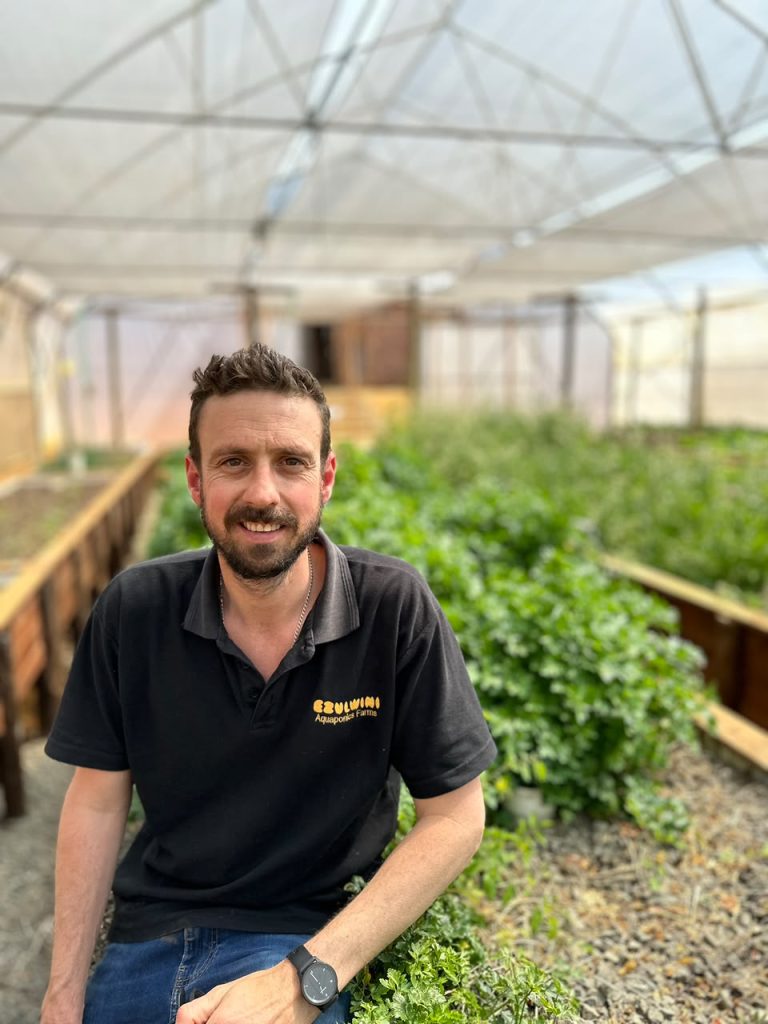
That pressure is all too familiar to Lliam Roach, founder of Ezulwini Africa, an aquaponics farming business that combines food production, technology and people development. His working day, like many South African entrepreneurs’, has always been long, with little room left to think beyond the next urgent task. For him, introducing systems into the business has helped create more space to focus on its bigger purpose.
Building more than a farm
“I’ve always loved building businesses, but over time I became more interested in building something that could actually make a meaningful difference,” says Roach. “South Africa has incredible people and incredible land, but we still struggle with unemployment and food security.”
For Roach, Ezulwini Africa is about more than growing lettuce. Its ambition is to create opportunities for young Black farmers to participate in agriculture in a meaningful and sustainable way – through jobs, skills transfer and building businesses designed to last. But, like many entrepreneurs, the early days were consumed by immediate pressures, with less strategic thinking.
“In the early days, everything lived in my head,” he says. “There were no systems, very little data, and we were making decisions based on gut feel. Like many small businesses, cash flow was always tight, and we were constantly under pressure, trying to do everything ourselves.”
More customers, more chaos – unless you’re ready for it
South African small businesses are looking to technology not just to survive but to get ahead: according to Xero’s State of Small Business research, 85% consider digital adoption a top or significant priority for the year ahead. Yet the same data reveals a telling tension: 84% are choosing steady growth or survival over aggressive expansion. Many businesses believe they will grow, but are wary of over-extending in a volatile economy. For many, the priority is not bold bets but better systems for steady growth.
For Roach, a key turning point came when he realised that relying on memory, effort and good intentions would not be enough to scale. “We had to systematise the business,” he says.
Ezulwini Africa began introducing accounting systems, task-management tools, reporting, production planning and digital records. Today, the team uses Xero for accounting, as well as tools for task management and collaboration, alongside crop-planning and reporting tools.
The result was not simply a more digital business. It was a more intentional one.
“Instead of reacting to problems, we started managing proactively. “For us, the biggest barrier wasn’t the technology itself, but finding the time to implement new systems. As entrepreneurs, we’re constantly busy, so putting new processes in place can initially feel like extra work. But once you get through that initial phase, you realise that technology actually gives you time back. Xero has become an important part of how we manage the business, and today, I can’t imagine running it without it.” says Roach.
More time for what matters
Automation is sometimes framed as a way to remove people from business processes. For small businesses, its value can be the opposite: it gives owners and teams more time to focus on customers, employees, partners and communities.
By reducing routine manual work such as capturing information, finding documents or managing everyday financial administration, digital tools can give business owners a clearer view of what is happening in their business.
For entrepreneurs, that visibility can be transformative. Xero’s research found that 52% of South African small businesses check profitability daily or weekly. That kind of visibility makes it easier to spot pressure points, plan ahead and make decisions with greater confidence – a significant shift for businesses that have historically operated on gut feel.
Turning numbers into decisions
Roach has seen this first-hand through working closely with an accountant.
“A good accountant doesn’t just do tax returns. They help you understand your numbers and make better decisions,” adds Roach.
Accurate management accounts and a stronger understanding of cash flow have changed how Ezulwini Africa approaches growth, funding applications, expansion and equipment investment. “Today, we make decisions based on data rather than emotion,” he says. “It gives us confidence because we understand the numbers behind those decisions.”
Nearly eight in 10 South African small businesses (78%) say their accountant or bookkeeper has been crucial to helping them survive. As routine compliance and administration become easier to manage through technology, accountants can spend more time helping clients interpret information, plan and navigate change.
A smarter future for farming
Agriculture presents its own version of the challenge. Farming is often viewed as hands-on work, but modern operations involve water quality, crop cycles, labour, logistics, customers and finances.
“Modern farming is really a data and systems business,” Roach says. “Many agricultural businesses are still heavily dependent on individuals rather than systems. That makes scaling difficult.”
Ezulwini Africa is working to build a repeatable operating system for farming, bringing together people, technology and practical knowledge. The business also uses AI for tasks including drafting funding proposals, analysing financial information, improving communications and structuring internal processes.
While 52% of small businesses use AI tools daily or weekly, 56% want more support understanding how it can fit their specific operations.
Roach’s advice is simple: “Start small. You don’t need to implement 10 systems overnight. Pick one thing that’s causing frustration and solve that first.”
Most importantly, he says, systems should not be seen as a substitute for people. “Systems don’t replace people – they support people. Good systems create consistency and free up time to focus on the important things.”
For Ezulwini Africa, that means building a stronger business while keeping sight of the people it aims to serve. Automation cannot replace that human purpose. But by taking on operational heavy lifting, it can help entrepreneurs move beyond survival mode – and start building for tomorrow.