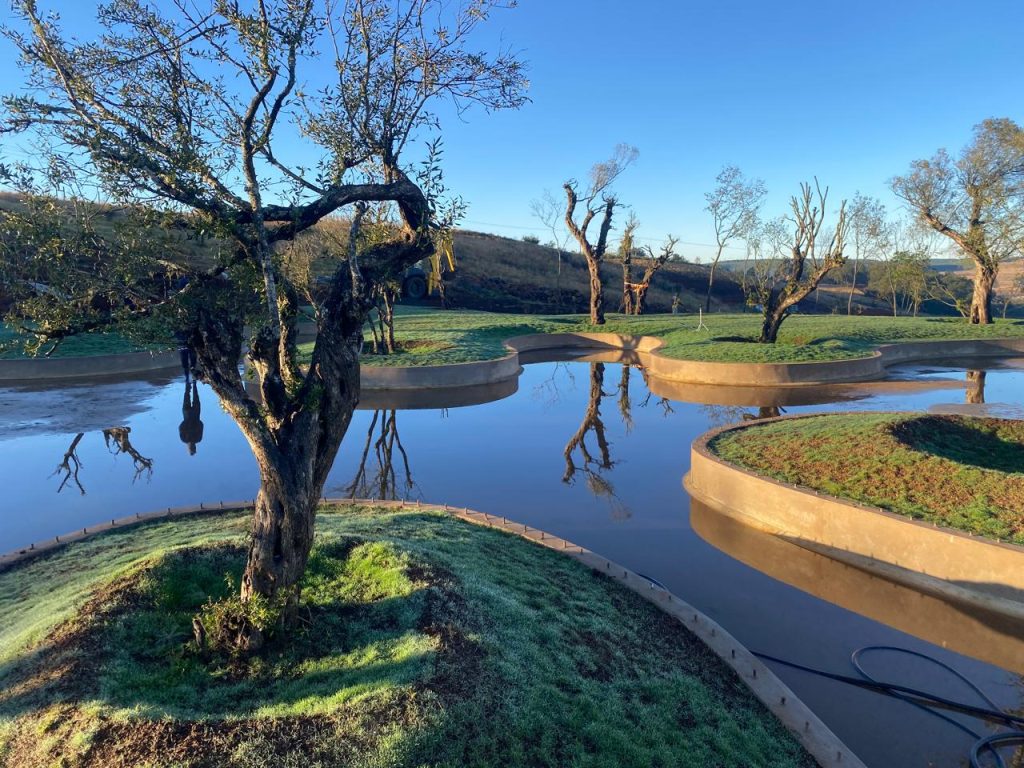
Construction of Brahman Hills’ 22-hectare Serenity Garden has passed the halfway mark, placing one of the world’s largest labyrinths on track for completion by the end of 2026.
Spanning an area equivalent to roughly 31 full-size football pitches within the Blue Crane Nature Reserve, the garden is taking shape through extensive earthworks, complex engineering and detailed planting.
Designed by landscape designer Tim Steyn, the garden is conceived as a contemporary interpretation of a labyrinth, with a single point of entry and exit and multiple paths unfolding across the site. “It’s part walking meditation, part contemplation and part strolling-style garden, with many different facets to unwind the mind and connect people to the present moment,” he explains.
Building within green walls
The site is enclosed by a double hedge of sweet viburnum and Leyland cypress, within which roughly six kilometres of exposed-aggregate concrete paths connect the garden’s many areas of interest. Guests are guided past waterfalls, streams, dry-packed stone walls and outdoor sculptures, before entering tunnels beneath the earth, to an Underground Orchid House and the African Art House. Local Midlands stone forms the dry-packed walls, streams and waterfalls, while extensive earthworks have created mounds, valleys and new landforms. Hundreds of extra-large trees have been relocated from surrounding farms, alongside tens of thousands of nursery-grown trees, shrubs, aloes, succulents and wild grasses.
Steyn credits founder Iain Buchan’s long-term thinking and leadership with guiding the many decisions required across the build. “This garden is the sum of so many parts, all of which require a huge amount of forethought and planning. Iain is a master at this, and his leadership filters down through every decision made.”
He adds that the unpredictable Midlands weather has been one of the project’s greatest technical challenges, with approval delays pushing portions of the build into a wet summer rather than the drier winter months. “Moving huge quantities of earth, stone and concrete is very challenging with the unpredictable Midlands weather,” Steyn says. “‘Four seasons in one day’ is an understatement during some months. Heavy mud and a few flash floods had to be worked around, but fortunately, we have a very experienced team on site that delivered Brahman Hills’ international award-winning Legacy Garden under similar conditions.”
A garden designed to change with the seasons
The planting palette spans seven zones chosen for design intent and climate adaptability. Salvias and wild grasses will bring a sweeping autumn display to the valleys beside the Underground Orchid House. Aloes and succulents will colour the Stone Labyrinth and the valley leading to Dragon’s Eye through winter, doubling as a nectar source for bees and birdlife. In spring, cherry blossoms and azaleas will transform the central waterways, with roughly six weeks of blossom marking winter’s end.
Indigenous Midlands mist-belt forest and thicket species will help rehabilitate parts of the site and support nesting birds and small mammals, while open valleys celebrate South Africa’s threatened grassland biome. Mixed woodlands of non-invasive oaks, plane trees, maples and liquidambars will provide established canopies and strong autumn colour.
Moments of pause and discovery
Among the garden’s defining features is the Stone Labyrinth, where an aloe and succulent collection curated by breeder Andy de Wet sits within a spiral of dry-packed stone walls. At Dragon’s Eye, guests enter an intimate waterfall space enclosed by the landscape. The Way of Water leads through a double-sided gorge of waterfalls to a larger cascade, its pool overlooked by Hanneke, the 4.5-metre sculpture by Sandro Trapani.
The route continues through the Olive Tree Garden, honouring some of the reserve’s oldest olive trees, and the African Art House, featuring works by Jane Bedford and pieces from Alex Zaloumis’s personal collection. At the Meditation Mound, an open window to the sky invites guests to lie back and unwind. The Underground Orchid House is curated by indoor plant specialists James Halle and Chris Dalzell, with outdoor sculptures by Tyron Selman offering further points of pause.
A legacy for our children’s children
For Brahman Hills, Serenity Garden is more than a landscape project; it forms part of founder Iain Buchan’s 100-year vision for a destination that will serve the Midlands and future generations.
When completed at the end of 2026, it will become yet another chapter in the Brahman Hills experience. A landscape that changes with the light, the weather and the seasons, rewarding guests who choose to slow down, stay longer and return throughout the year to discover its beauty anew.