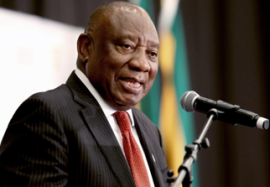
President Cyril Ramaphosa has called for urgent, coordinated action across all three spheres of government to resolve South Africa’s deepening water crisis, warning that poor municipal performance is placing an increasing burden on ordinary citizens.
Delivering the opening address at an Extended Presidential Coordinating Council (PCC) meeting in Boksburg on Thursday, the President placed the country’s water and sanitation challenges at the centre of government’s priorities, outlining reforms already underway, whilst calling for stronger accountability, improved financial management and technical capacity at local level.
The high-level meeting, held at the Birchwood Hotel and OR Tambo Conference Centre, brought together national, provincial and local government leadership in what President Ramaphosa described as a “historic get-together” aimed at strengthening coordination and delivering concrete solutions.
“This is the first time that the PCC holds an extended meeting that brings together all the mayors and municipal managers of our local government tier of government. You are all participating in a historic get-together,” he said.
President Ramaphosa said the deterioration of water services across municipalities has become one of the most immediate and widespread challenges facing the country, despite significant gains since the advent of democracy.
The meeting takes place as South Africa observes Freedom Month, which marks the country’s transition from the apartheid regime to a free, democratic country. It is in commemoration of the first democratic elections on 27 April 1994.
“There is no doubt that over the three decades of democracy, we have made great progress in extending access to water,” President Ramaphosa said, noting that over 82% of households had access to piped water by 2022, up from 61% in 1996.
However, he warned that reliability has worsened.
“The percentage of households that experienced water interruptions lasting more than two days at a time increased from 24% in 2012 to 34% in 2024,” the President said.
He attributed the crisis to a combination of ageing infrastructure, illegal connections, weak maintenance, poor revenue collection and institutional instability, adding that metros are losing vast amounts of water before it can even be billed.
“Our eight metropolitan municipalities are collectively losing an average of 34% of all water purchased before it can be billed. Some metros are approaching 50%,” he said.